Introduction: Rethinking the Impossible
For nearly a century, scientists have told us that black holes contain something truly bizarre at their centre: a singularity. This hypothetical point supposedly has infinite density and infinite curvature, where the normal laws of physics simply stop working. It's rather like saying "here be dragons" on old maps - it marks the edge of what we can understand.
But here's the thing about infinities in physics: they're usually nature's way of telling us we've made a mistake somewhere. When your equations start spitting out infinite answers, it typically means you're asking the wrong questions or making the wrong assumptions.
Quantum Boundary Horizon Theory (QBHT) suggests we've been making a fundamental error. What if there isn't anything inside a black hole at all? What if the event horizon - that mysterious boundary around a black hole - isn't a doorway to somewhere else, but simply the place where spacetime itself comes to an end?
The Problem with Traditional Black Holes
Three Paradoxes That Break Physics
Let's examine why our current understanding of black holes creates such headaches for physicists:
The Singularity Problem
General Relativity predicts that at the heart of every black hole sits a point of infinite density. But infinity isn't really an answer - it's physics throwing up its hands and admitting defeat. It's rather like a recipe that calls for "infinite salt" - it simply doesn't make sense in the real world.
The Information Paradox
Quantum mechanics has a fundamental rule: information cannot be destroyed. Ever. It can be scrambled, hidden, or transformed, but never completely erased. Yet if matter falls into a black hole and the black hole later evaporates through Hawking radiation, where does all that information go? Either quantum mechanics is wrong (which would overturn a century of successful physics), or something very clever is happening that we don't understand.
The Firewall Paradox
This is perhaps the most mind-bending problem. Quantum entanglement creates mysterious connections between particles. But the mathematics suggests that you can't simultaneously have entanglement between particles inside and outside a black hole AND between different bits of Hawking radiation. Something has to give - but what?
These aren't just academic puzzles. They represent genuine cracks in our understanding of how the universe works at its most fundamental level.
The Quantum Membrane: A New Kind of Boundary
When Spacetime Reaches Its Limit
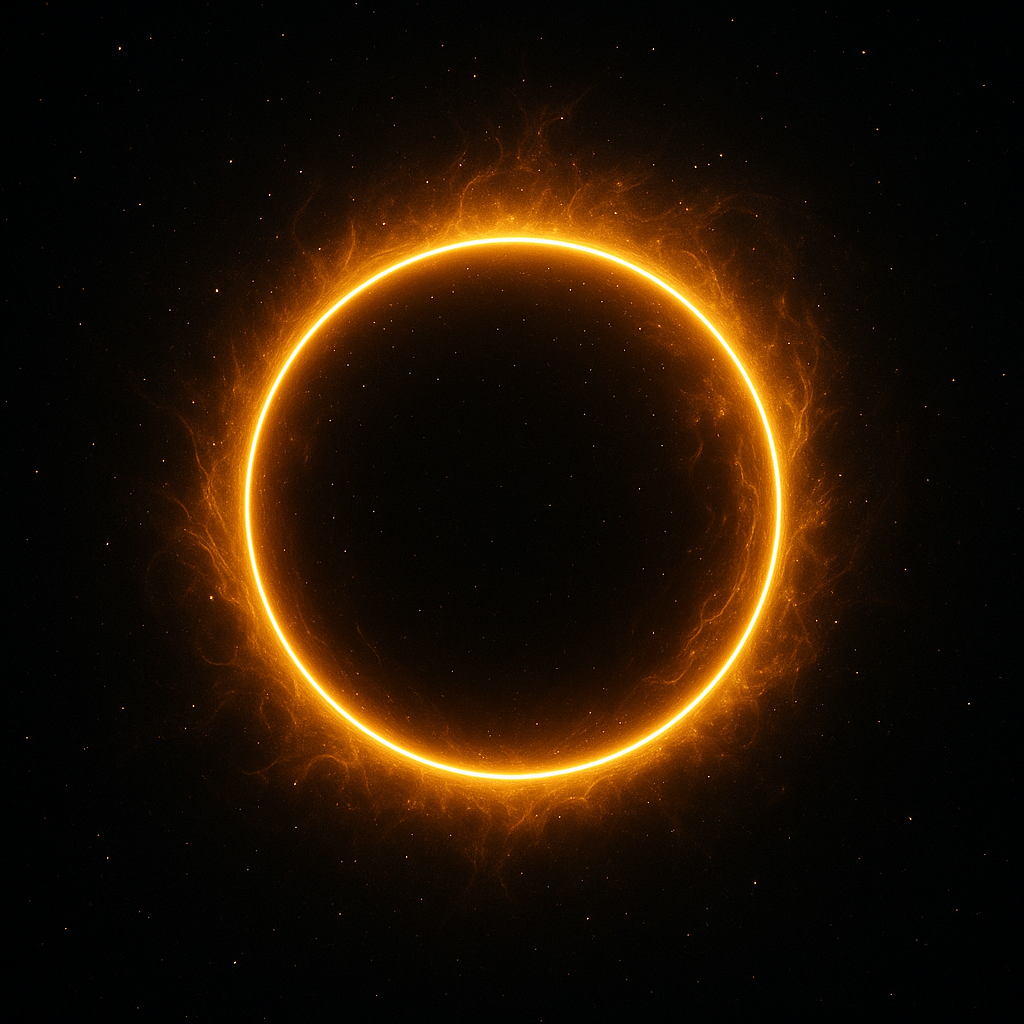
QBHT proposes something wonderfully simple yet profound: the event horizon is a real, physical boundary where spacetime simply ends. Think of it like the surface of a soap bubble - there's no "inside" the surface to speak of. The surface itself is the boundary of what exists.
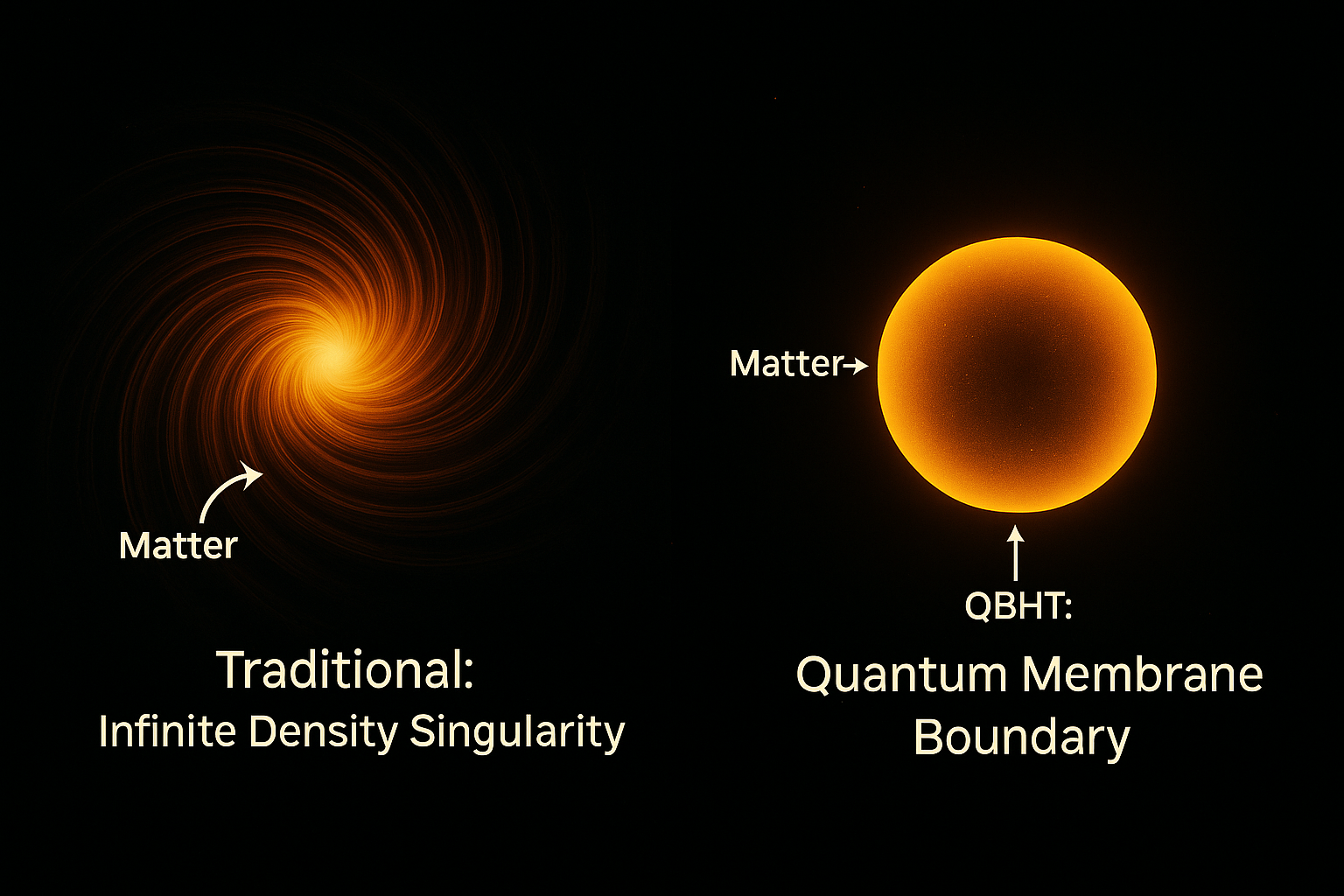
This quantum membrane forms through a process that's actually quite familiar from everyday physics. Just as water undergoes a phase transition and becomes ice when it gets cold enough, spacetime undergoes its own phase transition when gravitational forces become intense enough.
How the Membrane Forms
The process works rather like this:
Step 1: Approaching the Limit
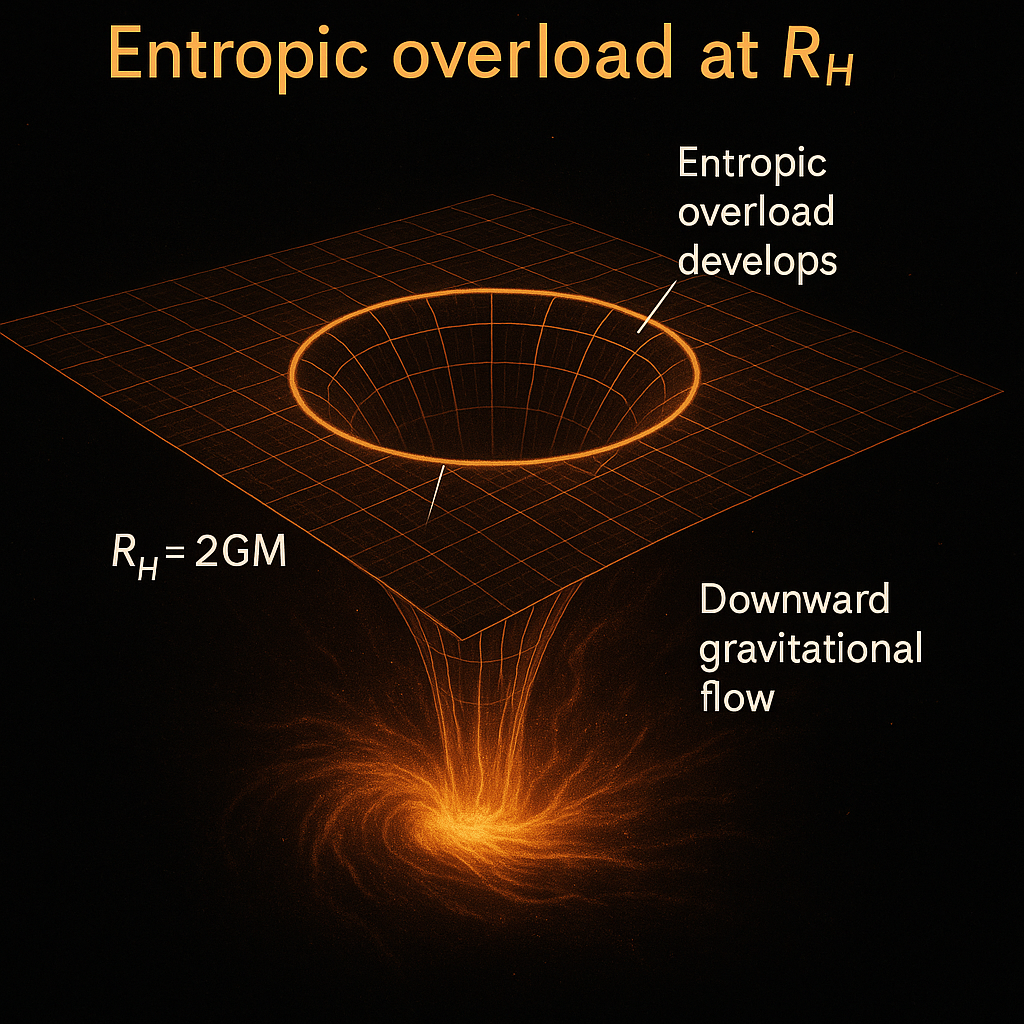
As matter collapses under its own gravity, it creates increasingly intense curvature in spacetime. Think of it like pressing down on a stretched rubber sheet - the more you press, the more it curves.
Step 2: Reaching Saturation
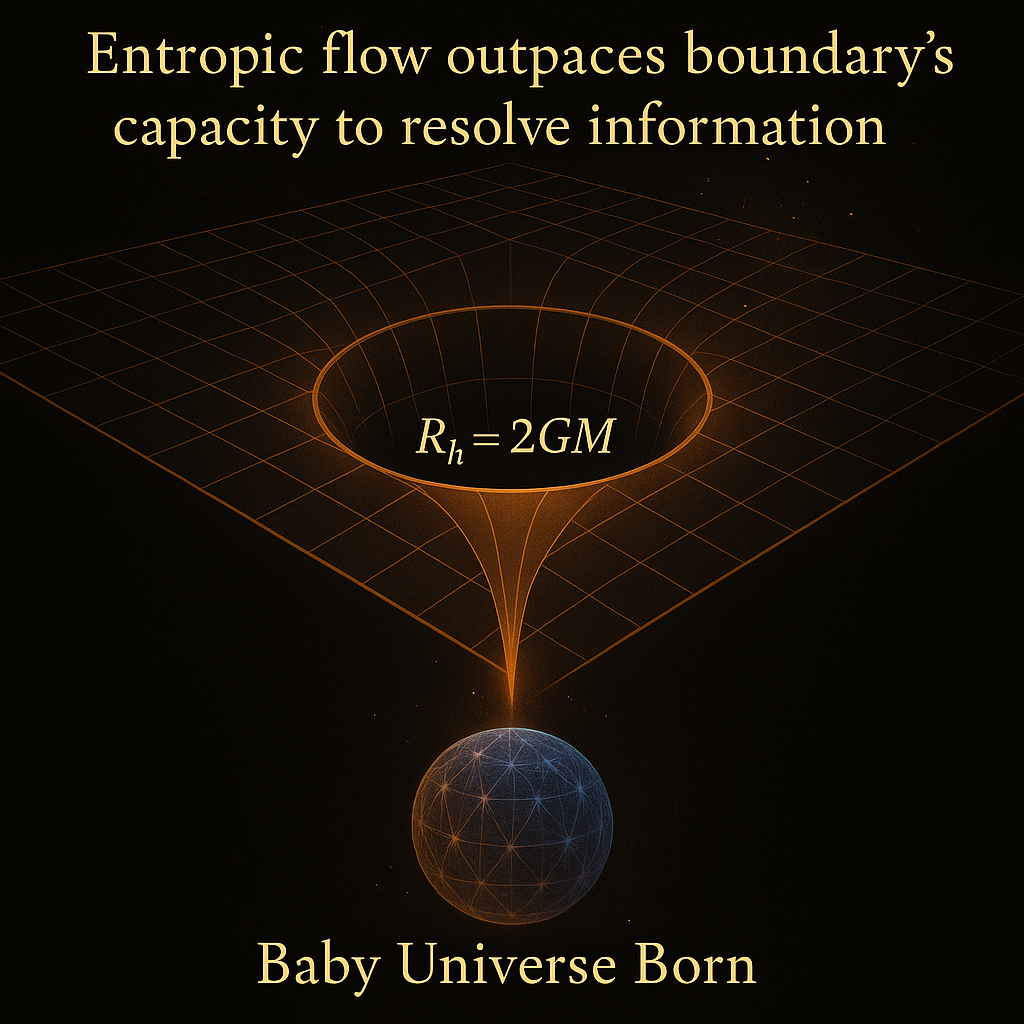
There comes a point where spacetime simply cannot curve any further without breaking. This happens when the quantum information density reaches its absolute maximum - rather like trying to pack more books into a library that's already completely full.
Step 3: The Phase Transition
At this critical point, spacetime undergoes a phase transition. A quantum field (mathematicians call it a scalar field) suddenly changes its behaviour, creating a stable membrane. This membrane has real physical properties - it has tension, it can store energy, and it can vibrate like a drumhead.
The remarkable thing is that this process uses only well-established physics. We don't need to invoke exotic extra dimensions or invent new particles. The membrane emerges naturally from quantum field theory operating under extreme conditions.
What Happens to Everything That Falls In?
The Cosmic Information Archive
Here's where QBHT becomes truly elegant. When matter approaches the black hole, it doesn't disappear into some mysterious interior. Instead, something far more sophisticated happens.
The Entanglement Process
As matter gets closer to the membrane, it becomes quantum mechanically entangled with the membrane's own quantum states. Think of it like two dancers becoming perfectly synchronised - they remain separate, but their movements become inextricably linked.
Information Encoding
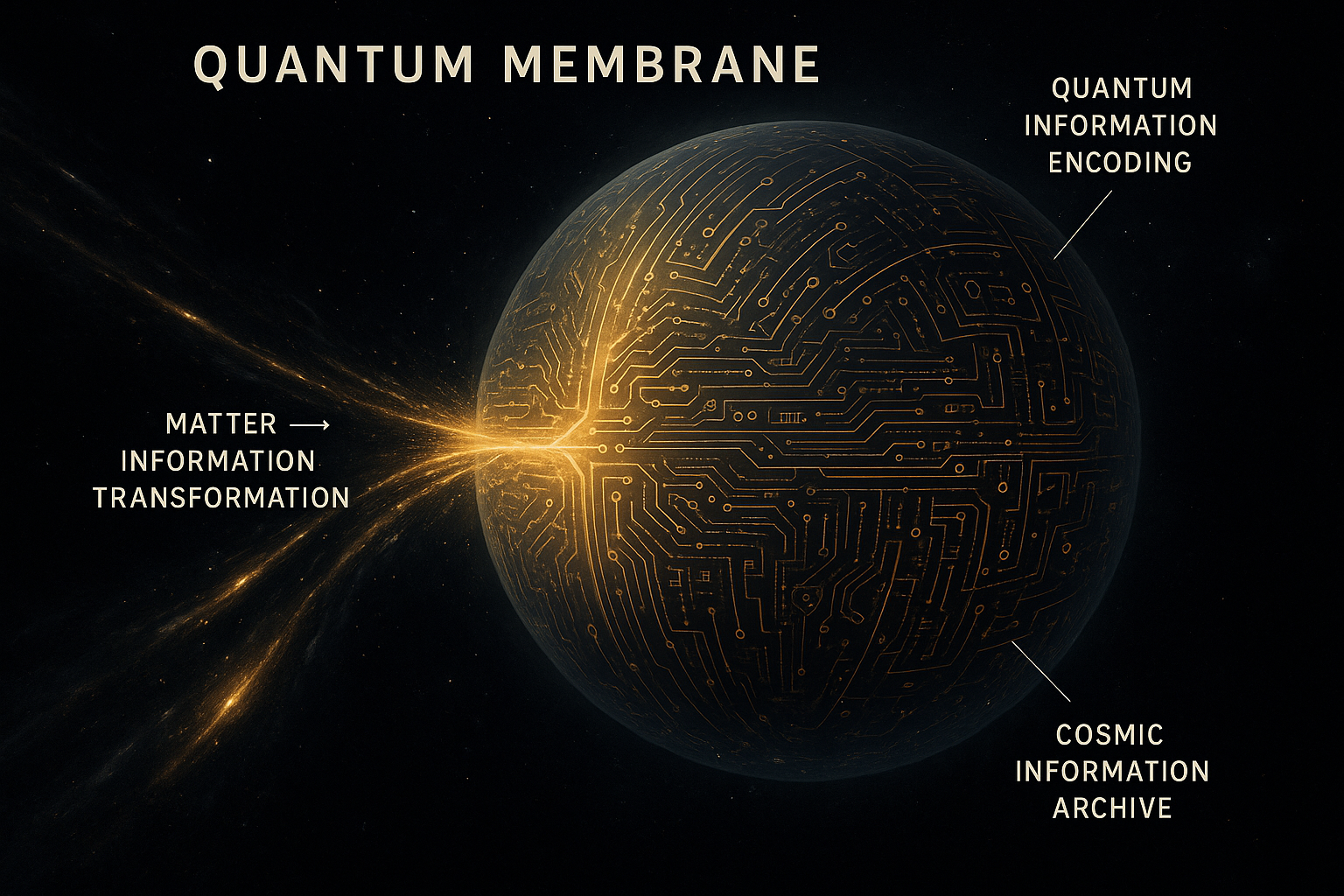
By the time the matter reaches the membrane, its quantum information has become completely woven into the membrane's structure. From the perspective of someone watching from far away, the matter never actually crosses the horizon - instead, its information gets spread across the membrane's surface like a vast, cosmic hard drive.
The Quantum Computer Analogy
You can think of the membrane as a spherical quantum computer. Each "bit" of information is encoded in tiny quantum fluctuations on the surface. The computer continues to process and evolve this information over time, following the strict rules of quantum mechanics that ensure nothing is ever lost.
This solves the information paradox in one elegant stroke. Information isn't destroyed - it's transformed and preserved in a new form.
Revolutionary Predictions: How to Test the Theory
Four Ways to Spot a Quantum Membrane
Unlike some theoretical frameworks that exist purely in the realm of mathematics, QBHT makes specific predictions that we can actually test with current or near-future technology:
1. Gravitational Wave Echoes
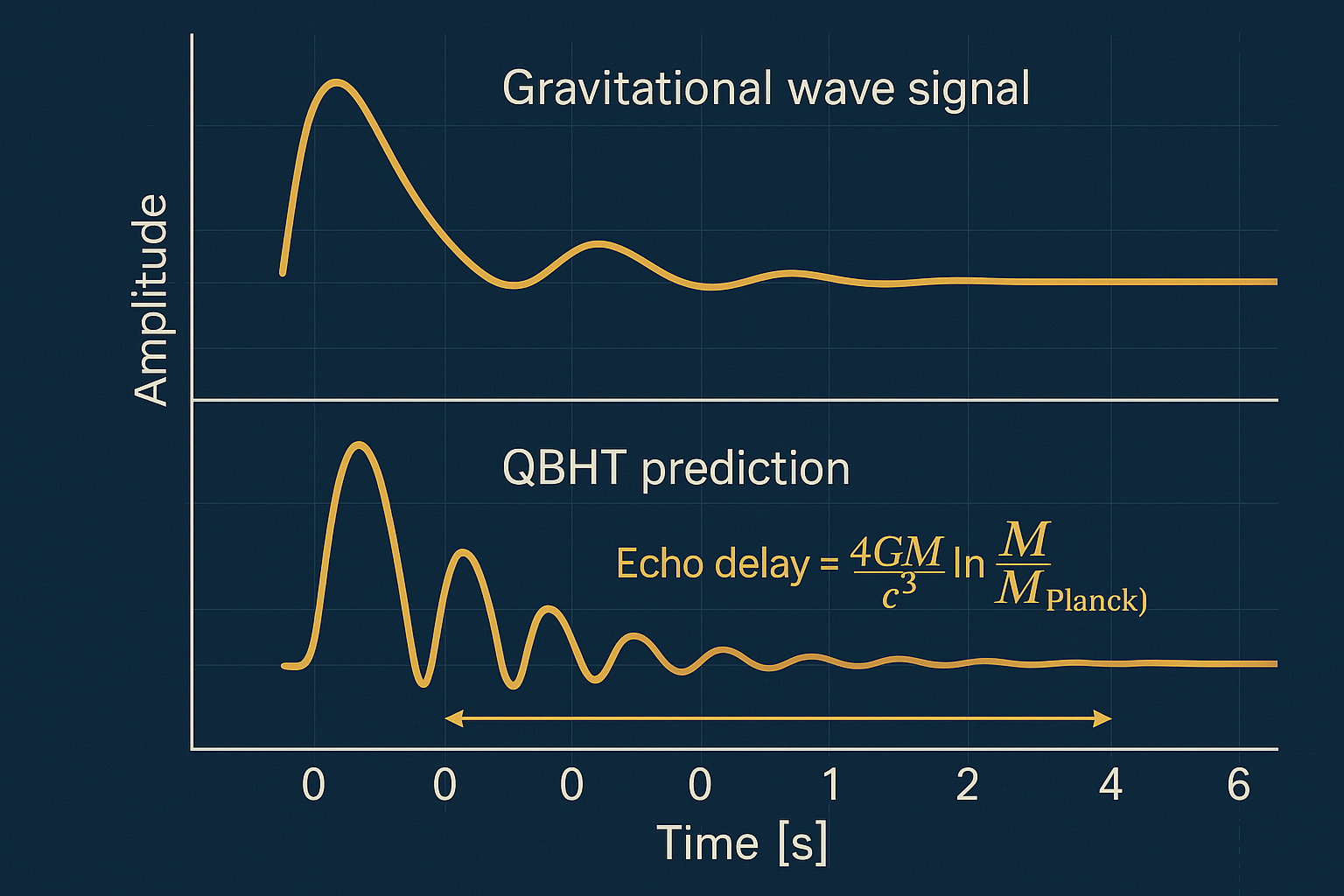
When two black holes merge, their quantum membranes should create distinctive "echoes" in the gravitational waves we detect. These echoes would arrive with a very specific timing pattern, roughly 4GM ln(M/M_Planck) time units after the main signal. Advanced gravitational wave detectors like LIGO and Virgo might already be sensitive enough to spot these signatures.
2. Structured Hawking Radiation
Traditional theory predicts that black holes emit perfectly featureless thermal radiation - rather like the glow from a perfect heat source. QBHT predicts something more interesting: the radiation should contain subtle quantum patterns that encode information about what fell into the black hole. It's the difference between random static and a carefully encoded message.
3. Membrane Oscillations
The quantum membrane should be able to vibrate in specific patterns, like different notes on a cosmic drum. These oscillations might create detectable patterns in both gravitational waves and electromagnetic radiation emitted from the vicinity of black holes.
4. Cosmological Signatures
If QBHT is correct, similar quantum membranes might form at much larger scales throughout the universe. The collective effect of many such membranes might even explain the mysterious dark energy that's causing our universe to expand at an accelerating rate.
How QBHT Differs from Other Approaches
A Clean Solution to Messy Problems
Several other theories have attempted to solve the black hole information paradox, but each comes with its own complications:
Fuzzballs (String Theory)
These replace the black hole interior with a tangle of quantum strings. While creative, this approach requires accepting string theory (which remains unproven) and doesn't maintain a clear horizon boundary.
Firewalls
This approach suggests that the event horizon is actually a wall of high-energy particles that destroys anything trying to cross it. It's rather dramatic, but it also violates some cherished principles about how spacetime should behave near horizons.
Gravastars
These are objects with a thin shell of matter surrounding an exotic vacuum interior. While avoiding singularities, they still require an interior space filled with hypothetical forms of matter.
QBHT's Advantage
QBHT is unique in proposing that spacetime simply ends at the horizon. There's no interior to worry about, no exotic matter to invent, and no violations of well-established physics principles. It's a remarkably clean solution to what seemed like impossibly messy problems.
The Mathematics: Sophisticated but Not Exotic
Building on Solid Foundations
The mathematical framework behind QBHT combines several well-established areas of physics:
Quantum Field Theory in Curved Spacetime
This mature field describes how quantum particles behave in the presence of strong gravitational fields. QBHT uses these established techniques to understand how fields behave near the membrane.
Phase Transition Physics
The membrane formation process uses the same mathematical tools that describe how water freezes or how superconductors work. The scalar field that creates the membrane follows a potential energy function that naturally drives it toward membrane formation when conditions become extreme enough.
General Relativity
The membrane must connect smoothly to the surrounding spacetime, following Einstein's equations. Special mathematical conditions (called junction conditions) ensure that the geometry remains consistent across the membrane boundary.
The beauty of QBHT is that whilst the mathematics is sophisticated, it doesn't require any exotic new physics. It's rather like building a complex cathedral using only well-tested engineering principles - ambitious in scope, but built on solid foundations.
Cosmic Implications: Beyond Black Holes
A New View of the Universe's Structure
If QBHT is correct about black holes, similar physics might apply to the universe as a whole. This opens up some fascinating possibilities:
Our Universe as a Membrane
The edge of our observable universe - the cosmic horizon beyond which we cannot see - might itself be a type of quantum membrane. This would mean our entire observable universe exists on the surface of an enormous cosmic bubble, with nothing "outside" in the conventional sense.
Dark Energy from Membrane Tension
The mysterious force causing our universe to expand at an accelerating rate might be explained by the collective tension of countless tiny quantum membranes scattered throughout spacetime. Each membrane would contribute a small amount of tension, but the cumulative effect across the entire universe could account for the observed acceleration.
A Foam-Like Cosmos
At the largest scales, spacetime might have a foam-like structure, with different regions separated by quantum membranes. This could provide a new framework for understanding how our universe connects to other possible universes or cosmic domains.
Looking Ahead: The Future of Spacetime Physics
From Theory to Discovery
We stand at a remarkable moment in physics. For the first time, we have the technology to directly test some of humanity's most profound theories about the nature of reality. Gravitational wave detectors, advanced telescopes, and quantum laboratory experiments are giving us unprecedented access to the extreme physics that governs black holes.
The Next Decade
Advanced LIGO and Virgo are already detecting gravitational waves from black hole mergers on a regular basis. As these instruments become more sensitive, they may soon be able to detect the subtle echo signatures that QBHT predicts. Similarly, the Event Horizon Telescope and its successors might resolve unexpected structure at the horizon scale of supermassive black holes.
A New Paradigm
If QBHT proves correct, it will represent more than just a new theory of black holes. It suggests a fundamental shift in how we think about the boundaries of reality itself. Rather than thinking of spacetime as an infinite stage upon which physics plays out, we might need to envision it as a finite, bounded information-processing system.
This could have profound implications for our understanding of consciousness, computation, and the ultimate nature of physical reality. The boundary between the possible and the impossible might literally be where the most important physics happens.
Conclusion: Where Endings Become Beginnings
Quantum Boundary Horizon Theory represents more than just a solution to black hole paradoxes. It offers a new way of thinking about some of the deepest questions in physics: What is the relationship between information and reality? How does quantum mechanics connect to gravity? What are the ultimate boundaries of the physical universe?
By proposing that spacetime has real, physical edges - quantum membranes where information is processed and preserved - QBHT suggests that the universe is both stranger and more comprehensible than we imagined.
The event horizon isn't where physics breaks down. It's where physics becomes most fundamental, most elegant, and most profound.
Perhaps the most remarkable thing about QBHT is its essential optimism. It suggests that even at the most extreme boundaries of physical reality - places where we once thought everything simply ended in chaos and confusion - there is still order, still logic, and still hope for understanding.
The end, as it turns out, might be where the most important discoveries begin.
About the Author: Richard H Harris MBE, BSc is an independent theoretical physicist developing new approaches to quantum gravity and black hole physics. His work spans the intersection of quantum field theory, general relativity, and information theory.